
How Much Does It Cost to Sell a House in California? A South Bay Net Sheet
Last updated October 28, 2026
In my example net sheets, selling costs come to about $82.5k (5.5% of the price) on a $1.5M Torrance sale and about $133k (5.3%) on a $2.5M Palos Verdes Estates sale, before your mortgage payoff and income tax. Those percentages come from the illustrative sheets below. They are not a quoted or standard rate. Roughly three quarters of each total is agent compensation, which is negotiable and set by agreement. I used an illustrative 4% combined only so the math is complete. The fees I can source are small: county transfer tax of $1.65k and $2.75k, an owner's title policy of $3.15k and $4.11k from one insurer's filed rate schedule, and a $435 buyer's home warranty from Fidelity National Home Warranty's California price list. When I represent you, I pay for the buyer's home warranty, so it costs you $0 and your totals are $435 lower. Escrow, repairs, staging and report amounts are my labeled estimates. Torrance and Palos Verdes Estates add no city transfer tax. Redondo Beach does. This is general information, not tax or legal advice, and it is not a promise of what your home will net.
"How much does it cost to sell a house in California?" is one of the questions I hear most from South Bay homeowners, and a lot of people search for it. The honest answer is that your costs depend on your price, your mortgage, your home's condition and, most of all, on what you negotiate. So instead of quoting a single number, I built two line-by-line net sheets: a $1.5M sale in Torrance and a $2.5M sale in Palos Verdes Estates. Every line says whether it is sourced (from the LA County Registrar-Recorder, a city code or fee schedule, the California Department of Real Estate, the California Department of Insurance, C.A.R. or the IRS) or an illustrative assumption of mine. I do not use any online home-value estimates here.
What does a line-by-line net sheet look like for a South Bay sale?
Here are both examples side by side. Table amounts are in full dollars. Please treat the illustrative lines as placeholders for scale. Your own numbers will differ, and I would replace every one of them with real quotes before you decide anything.
| Line item | Source or basis | Torrance $1,500,000 |
Palos Verdes Estates $2,500,000 |
|---|---|---|---|
| Agent compensation, both sides (illustrative 4% of price, negotiable) | Illustrative. Not a standard rate. | $60,000 | $100,000 |
| County transfer tax ($1.10 per $1,000) | Sourced: LA County Recorder | $1,650 | $2,750 |
| City transfer tax | Sourced: Recorder's city list | $0 | $0 |
| Owner's title insurance policy (seller customarily pays) | Sourced: one insurer's filed rates | $3,150 | $4,113 |
| Escrow fee, seller's half | Illustrative: fee $3,500 and $4,500 | $1,750 | $2,250 |
| Natural hazard disclosure report | Illustrative | $125 | $125 |
| City resale paperwork | Sourced for PVE. Torrance: no fee found | $0 | $188 |
| Wire, courier, notary, recording | Illustrative | $400 | $400 |
| Repairs and buyer credits | Illustrative. Range $0 to $25k and $0 to $40k | $10,000 | $15,000 |
| Staging and cleanup | Illustrative. Range $0 to $10k and $0 to $15k | $5,000 | $8,000 |
| Home warranty for the buyer (Fidelity Standard Plan, 1 year, single family) | Sourced: Fidelity CA price list. Often seller-paid, negotiable | $435 | $435 |
| HOA documents and prorated property taxes | $0 here. HOA only if you have one. Taxes are timing. | $0 | $0 |
| Total selling costs | Sum of the lines above | $82,510 | $133,261 |
| Total as a percent of price | Illustrative result | 5.5% | 5.3% |
| Estimated proceeds before mortgage payoff and income tax | Price minus total selling costs | $1,417,490 | $2,366,739 |
| Less: mortgage payoff | Your lender's payoff statement | Your number | Your number |
Sources for each sourced line are in the sections below and in the Sources list. Illustrative means my own assumption, not a statistic. "Torrance: no fee found" means the city's smoke detector certificate form that I read shows no fee, and I did not find a city fee schedule entry for it. When I represent you, I pay for the buyer's home warranty, so it costs you $0. I kept the $435 in the totals so the sheet works for any seller. With me, each total is $435 lower, about $82.1k and $132.8k, and the percentages still round to 5.5% and 5.3%.
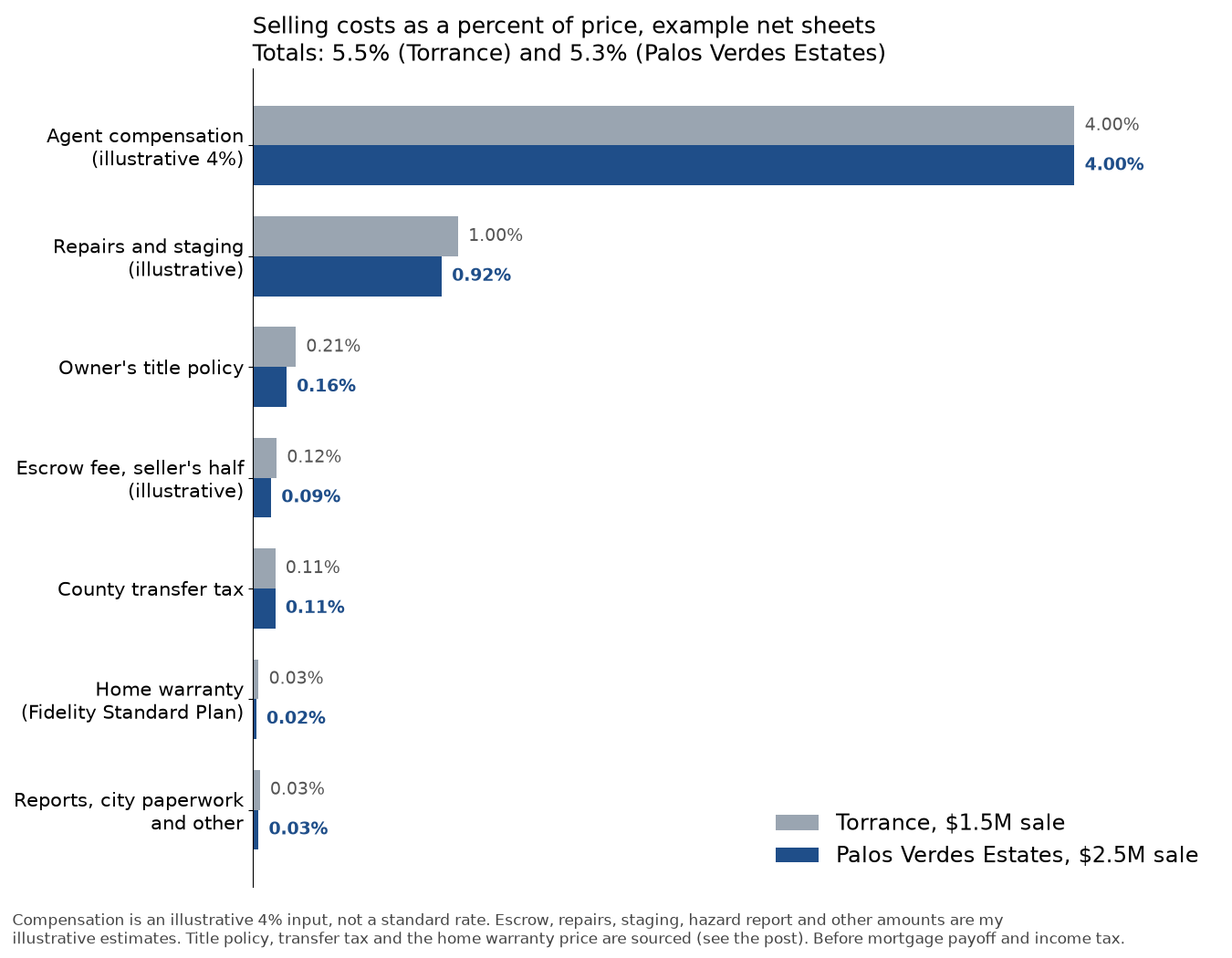
Two things move the bottom line more than anything else. Each 1 percentage point of compensation is $15k on a $1.5M sale and $25k on a $2.5M sale. And repairs and staging are entirely your call. The government and third-party fees are small by comparison, which is why I focus on what you can control, near the end of this post.
How much are listing and buyer-agent compensation?
It is whatever you negotiate. California law says so directly. Business and Professions Code section 10147.5 requires listing agreements to carry this notice in bold type: “The amount or rate of real estate commissions is not fixed by law. They are set by each broker individually and may be negotiable between the seller and broker.” The Department of Real Estate goes further: its consumer alert says any agent who claims there is a standard commission rate is misrepresenting the law.
The buyer side changed after the nationwide settlement. The DRE's licensee advisory explains that sellers and their listing agents no longer determine what a buyer's agent is paid. Buyers' agents now negotiate directly with their own client in a signed representation agreement, which California has required since January 1, 2025. A buyer can pay their agent out of pocket or ask the seller to cover some or all of it as a concession, which the seller may accept or reject.
So on your net sheet there are two separate questions. First, what we agree on for my services in the listing agreement. I am a REALTOR with Real Brokerage, and my compensation is set in that written agreement with you, not by a rate card. Second, whether you choose to contribute anything toward a buyer's agent, and how much, when an offer comes in. Both are conversations, and I will walk you through each before you sign anything. I used a combined 4% in the table purely as a round, illustrative input.
Who pays escrow and title fees in Los Angeles County?
By custom, in Southern California the seller pays for the owner's title insurance policy and the county transfer tax, and the seller and buyer split the escrow fee. That is how the DRE's escrow guide for consumers describes it, and the California Department of Insurance says the same about title insurance: “In Southern California, the seller customarily pays the premium for title insurance.” A title insurer's 2026 California customary practices guide lists Los Angeles County the same way: escrow split between buyer and seller, owner's title policy paid by the seller, county transfer tax paid by the seller, and any city transfer tax paid by the seller. The buyer usually pays for the lender's title policy.
These are customs, not laws. The CDI notes that who pays the premium “is a matter of local custom and practice and not set by law,” and the DRE says the buyer and seller may agree to any arrangement, written into the purchase contract. In the C.A.R. residential purchase agreement, each of these costs has its own box where the parties record who pays.
- Title policy amount. Every title insurer must file its rates with the Insurance Commissioner, so rates differ by company. As one filed example, Old Republic Title's Los Angeles schedule, effective March 17, 2025, lists a standard owner's policy premium of $3.15k at $1.5M (see its rate page) and $4.11k at $2.5M (see its next rate page). Other insurers file different rates, and the CDI says you can save money by comparing. The person who pays for the policy picks the title company.
- Escrow fee. The DRE says escrow fees are not fixed by law or regulated by the state, and that you can shop around and try to negotiate before you enter escrow. I could not find a primary source for a Los Angeles County dollar figure, so my sheet uses an illustrative whole fee of $3.5k on $1.5M and $4.5k on $2.5M, and the seller pays half. Please get a written estimate from the escrow company before you rely on it.
Who pays for the buyer's home warranty?
Often the seller does, but it is negotiable. A home warranty is a one-year service contract that covers repairs to many of the home's systems and appliances after the buyer moves in. The C.A.R. residential purchase agreement has a box for it, like the other costs above, where the parties record whether the buyer or the seller pays and the plan cost. It is not required by law.
For my sheets I used Fidelity National Home Warranty. Its current California brochure and price list (plan version P13A, dated September 21, 2026) lists the Standard Plan for a single family home in a real estate transaction at $435 for 1 year, with a $100 trade call fee per service request. The Standard Plan does not include air conditioning. That is a $100 option for 1 year, and I did not add it to the sheet. Higher plans run from $530 (Standard Plus) to $865 (Enhanced Plus) for a single family home. The price list covers homes under 5,000 square feet. For larger homes it says to call for a quote, and I could not find a published price, so I do not show one. Both examples assume a single family home under 5,000 square feet.
When I represent you, I pay for the buyer's home warranty, so it costs you $0.
What is the transfer tax in LA County, and do South Bay cities add their own?
The Los Angeles County Registrar-Recorder charges a documentary transfer tax of $0.55 for each $500 of value, which is $1.10 per $1,000, on documents that convey real property in the county's cities. That is $1.65k on $1.5M and $2.75k on $2.5M. It is collected when the deed records, and by custom the seller pays it.
Some city codes also contain a transfer tax ordinance, so I checked. The Recorder's list shows an additional city tax in only five cities: Culver City, Los Angeles, Pomona, Redondo Beach and Santa Monica. Here is how that plays out for the South Bay:
| City | Extra city transfer tax? | What it means for you |
|---|---|---|
| Torrance | No | County $1.10 per $1,000 only. The city code sets 27.5 cents per $500, the city's half share, which state law credits against the county tax. |
| Palos Verdes Estates | No | County only. The city code sets the same 27.5 cents per $500 city share, credited the same way. |
| Rancho Palos Verdes | No | County only. The city code sets the same 27.5 cents per $500 city share. |
| Manhattan Beach, Hermosa Beach, El Segundo, Rolling Hills Estates, Rolling Hills, Lomita | No | County only. None is on the Recorder's list of cities with an additional tax. |
| Redondo Beach | Yes | Adds $2.20 per $1,000 on top of the county tax. The city code sets $1.10 per $500. On $1.5M that is an extra $3.3k, for $4.95k in total transfer tax. |
| San Pedro (City of Los Angeles) | Yes | Adds $4.50 per $1,000 ($2.25 per $500). For sales above $5.4M, the Recorder's list adds a 4% Measure ULA tax (5.5% from $10.9M), effective July 1, 2026. On $1.5M the city tax is $6.75k. |
The state law behind the credit is Revenue and Taxation Code section 11911: a city may impose half of the county rate, and the county tax is credited by the amount of that city tax. Cities not listed here are not covered by this table, and rates can change, so I confirm the current rate with the Recorder when I build your sheet.
What do natural hazard reports, disclosures and city resale paperwork cost?
California sellers must give buyers a set of statutory disclosures, including a Real Estate Transfer Disclosure Statement and a Natural Hazard Disclosure Statement. The natural hazard statement covers flood, dam inundation, fire hazard severity, earthquake fault and seismic hazard (landslide and liquefaction) zones, and the form is set out in Civil Code section 1103.2. Sellers commonly order a third-party report to complete it. The C.A.R. purchase agreement has a box for who pays for it. I used an illustrative $125 in the sheet, which is a placeholder, not a quote.
Some cities also require their own paperwork at sale, and this is where the two examples differ:
- Torrance. The city's smoke detector certificate form quotes Torrance Municipal Code section 81.2.9, which requires working smoke detectors when a dwelling changes ownership, certified by the owner or installer. The city form that I read shows no fee, so I put $0 and did not find a fee schedule entry.
- Palos Verdes Estates. Chapter 5.25 of the city code requires the owner to obtain a Real Property Records Report from the city before the sale closes and deliver it to the buyer. It requires no inspection, the city must deliver it within five business days of a complete application, and it expires after six months. The city's fiscal year 2025-26 master fee schedule lists the report at $188 (up from $183), and I used $188. Please confirm the current fee with the city.
Other South Bay cities have their own rules, and some differ from these. I check the current requirement for your city before we list. State law may also require smoke alarm and carbon monoxide device installation and water heater bracing, and the purchase agreement has a box for who pays for it.
How much should I budget for repairs and staging?
This is the biggest line you control, and I have no primary source for it, so every figure here is an illustrative assumption. For scale, my sheet uses $10k of repairs and buyer credits plus $5k of staging and cleanup for the Torrance example, and $15k plus $8k for Palos Verdes Estates. Your own number could be $0 if you sell as is, or well above mine. I would get written bids before you decide.
One thing to know about timing: in the purchase agreement, the box that decides who pays for an inspection report does not decide who pays for any work the report recommends. Repairs are negotiated after the buyer's inspections, which is why some sellers fix the obvious items first. Whether to do that, and how much, depends on your home, and I give my honest read of what will matter to buyers on your street.
How do the mortgage payoff and property taxes work at closing?
Mortgage payoff. Escrow requests a payoff demand from your lender and arranges the lien release. The DRE's escrow guide lists requesting payoff demands and lien releases among the escrow officer's core tasks. Your payoff comes out of your proceeds, and it is your number, not something I can estimate for you, so the table leaves it blank. Ask your lender for a payoff statement as soon as you think you might sell.
Prorated property taxes. The LA County Treasurer and Tax Collector says secured property taxes are typically prorated between buyer and seller during escrow. The tax year runs July 1 to June 30. The first installment is due November 1 and becomes delinquent after December 10. The second is due February 1 and becomes delinquent after April 10. From July 1 to October 1 the new bill is not available, so escrow estimates the amount and credits or debits you both.
Proration is a timing item, not an extra cost: you pay the taxes for the days you owned the home. Here is an illustration with made-up numbers. Say your annual bill is $10k, you have paid both installments, and you close on April 30. The buyer would credit you for May 1 through June 30, which is 61 days, or roughly $1.67k. If you had not paid the second installment yet, escrow would charge you for the days through closing instead. Escrow does the exact math. That is why the table shows $0.
What if my home is in an HOA?
Then there is one more cost. Civil Code section 4525 requires the owner of a home in a common interest development to give the buyer documents such as the governing documents, a statement of current assessments and fees, and any unresolved violation notices. The association can charge the seller a reasonable fee based on its actual cost, and section 4530 says it is the seller's responsibility to pay the company that provides the documents. The C.A.R. purchase agreement also has boxes for any HOA transfer fee. I have no sourced dollar figure because every association is different, so I show $0, and I ask for the association's written estimate before we list.
Will I owe capital gains tax when I sell?
Maybe not. IRS Publication 523 says that if you meet the conditions, you may exclude the first $250k of gain from the sale of your main home from your income, or $500k for a married couple filing jointly. To qualify for the full amount you generally must have owned the home for at least 24 months and used it as your main home for at least 24 months in the 5 years before the sale, and generally you cannot have excluded gain on another home sold in the prior 2 years. IRS Topic 701 adds that if you receive a Form 1099-S you must report the sale even if the gain is excludable.
Your selling costs matter here. The Pub 523 worksheet subtracts selling expenses, such as sales commissions, advertising and legal fees, from the sale price to get the amount realized, and it notes that transfer taxes paid by a seller can be treated as selling expenses. Your CPA decides which of your costs count.
Here is an illustration with made-up numbers, not a prediction. Say you paid $600k and have $100k of documented improvements, so your basis is $700k. You sell for $1.5M and have $70k of qualifying selling expenses. Your gain is $730k. A married couple filing jointly who qualify could exclude up to $500k, leaving about $230k that may be taxable. A single owner could exclude up to $250k, leaving about $480k. I do not cover federal or California tax rates here, because they depend on your whole tax picture.
What can I control?
- Compensation. Both sides are negotiable and in writing. Ask what services are included and how the buyer-side contribution would work.
- Your escrow company and your title insurer. The DRE says you can shop escrow fees and negotiate before you enter escrow, and the CDI says title rates differ by company and that the person who pays picks the company.
- Who pays what. Customs in LA County are a starting point. The purchase contract is where the allocation is actually decided.
- How much you spend on prep. Get bids first. Spend where buyers will notice, and skip projects that do not matter to a buyer on your street.
- Your paperwork timeline. Order HOA documents, city reports and your disclosures early, so a delay in one of them does not hold up your sale. Selling as is does not remove your disclosure duties.
- Your tax position. The ownership and use tests are about dates. Talk to a CPA before you list, especially if you rented the home out or are close to a 2-year mark.
What you cannot control: the county transfer tax rate, a city's tax or paperwork rules, and the exact amount your lender says you owe.
So how much does it cost to sell a house in California?
In these two South Bay examples, about 5.3% to 5.5% of the price, before payoff and income tax. That is a result of my illustrative inputs, and the largest line is the one you negotiate. The fees that are set by government or filed with the state are a small slice, $4.8k and $6.86k for transfer tax plus a title policy. The best way to get your real number is a net sheet built from your address, your mortgage payoff, a written escrow estimate and a title quote. Nothing here is a promise of what your home will sell for or net, and nothing here is tax or legal advice. Please confirm tax questions with a CPA and legal questions with an attorney.
Frequently asked questions
Who pays closing costs when you sell a house in Los Angeles County?
By custom, the seller pays for the owner's title insurance policy and the county transfer tax, and the buyer and seller split the escrow fee. The California Department of Real Estate and the California Department of Insurance both describe Southern California this way. These are customs, not laws. The buyer and seller can agree to any split in the purchase contract. In my examples, transfer tax plus the title policy come to $4.8k on a $1.5M Torrance sale and $6.86k on a $2.5M Palos Verdes Estates sale.
Does the seller pay for the buyer's home warranty in California?
Often, but it is negotiable and not required by law. The C.A.R. purchase agreement has a box where the buyer and seller record who pays. Fidelity National Home Warranty's current California price list shows its Standard Plan for a single family home at $435 for 1 year. Homes over 5,000 square feet need a quote. When I represent you, I pay for the buyer's home warranty, so it costs you $0.
Is there a standard real estate commission in California?
No. California law says the amount or rate of real estate commissions is not fixed by law, that each broker sets them individually, and that they may be negotiable. The Department of Real Estate says an agent who claims a standard rate is misrepresenting the law. Since the nationwide settlement, buyers' agents negotiate their compensation directly with their buyer, and a seller may accept or reject a request to cover some or all of it. The 4% combined figure in my example sheets is only an illustrative input.
Do Torrance, Palos Verdes Estates and Redondo Beach charge different transfer taxes?
Redondo Beach does, and Torrance and Palos Verdes Estates do not. The LA County Registrar-Recorder lists only five cities with an additional city tax: Culver City, Los Angeles, Pomona, Redondo Beach and Santa Monica. Redondo Beach adds $2.20 per $1,000 on top of the county's $1.10 per $1,000. On a $1.5M sale that is $3.3k extra, for $4.95k in total. Torrance and Palos Verdes Estates pay the county rate only, which is $1.65k on $1.5M.
Do I have to pay capital gains tax when I sell my house?
Maybe not. Per IRS Publication 523, if you owned and used the home as your main home for at least 2 of the 5 years before the sale, you can generally exclude up to $250k of gain, or $500k for a married couple filing jointly. Gain above that may be taxable. Selling costs can reduce the gain, and your CPA decides which count. This is general information, not tax advice.
Can I sell as is to avoid repair costs?
Often you can, but selling as is does not remove your disclosure duties. Unless you are exempt, California requires statutory disclosures such as the Transfer Disclosure Statement and the Natural Hazard Disclosure Statement, and some cities require their own sale paperwork. Buyers can still inspect and ask for credits or repairs. As is can save prep spending, and it can affect what buyers offer. I would compare both before you choose.
Data sources and notes
Sourced lines: LA County Registrar-Recorder documentary transfer tax page and city list; Revenue and Taxation Code section 11911; the Torrance, Palos Verdes Estates, Rancho Palos Verdes and Redondo Beach city codes; the Palos Verdes Estates fiscal year 2025-26 master fee schedule; California DRE consumer alert, licensee advisory and escrow guide; California Department of Insurance title insurance guide; one title insurer's filed Los Angeles County rate schedule (effective March 17, 2025) and its 2026 customary practices guide; the C.A.R. residential purchase agreement sample form (the free public sample is the December 2018 edition, so the current member edition may differ); California Civil Code sections 1103.2, 4525 and 4530; Business and Professions Code section 10147.5; the LA County Treasurer and Tax Collector; IRS Publication 523 (2025) and Topic 701. Fidelity National Home Warranty's California brochure and price list (plan version P13A, September 21, 2026). Illustrative lines: the 4% combined compensation input, escrow fees, natural hazard report, other closing charges, repairs, staging, and all examples of property tax proration and capital gains. Rates, fees and rules change, so confirm each before you rely on it. This post is general information and not tax or legal advice.
Want to see your own numbers? I will build a free net sheet for your address: the county and city transfer tax for your city, a title and escrow estimate, the disclosures and city paperwork your sale needs, and your mortgage payoff. There is no pressure to list. Start with a free home evaluation or reach out with your address.
Zoltan
Categories
Recent Posts





Realtor®, SRES®, South Bay Real Estate Agent | Hermosa Beach, Manhattan Beach & Palos Verdes License ID: 02248774
+1(661) 234-6442 | zoltan@sellwithzoli.com